
Saturday, April 1, 2017

Friday, March 31, 2017
5 Natural Alternative Deodorants
5 Natural Alternative Deodorants
Great article from Mother Nature Network

 Never underestimate the power of a lemon. (Photo: electric.porcupine/Flickr)
 Photo used with permission from Amy Karol
Great article from Mother Nature Network
If you’re concerned about the health effects of regular deodorants, here are some options.
There are plenty of options beyond what you see on the typical grocery store shelf. (Photo: Alliance/Shutterstock)
Stores stock a variety of deodorants and antiperspirants, but if you’re concerned about the health or environmental effects of using such products, there are alternatives. While some people are worried about common deodorant chemicals like parabens, formaldehyde and triclosan, most concerns focus on aluminum, the ingredient in antiperspirant that blocks pores and fights wetness. Aluminum is rumored to be linked to breast cancer and other diseases; however, the National Cancer Institute says this research is inconclusive. In addition to these potential health risks, aluminum mining is also destructive and polluting. If you’re thinking twice putting such ingredients on your body, check out these natural deodorant alternatives.
1. Natural deodorants
If you're looking for a more natural deodorant, there are a variety of options available. Deodorant stones are large, smooth crystals of potassium aluminum sulfate that must be wetted and applied like a regular deodorant stick. The difference between potassium alum and aluminum chlorohydrate, according to natural health proponents, is that potassium alum is a much larger molecule that's not thought to be absorbable through skin. However, if you want to completely eliminate aluminum from your armpits, there are many natural deodorants on the market. Burt's Bees, JASON, Trader Joe's, Kiss My Face and several other companies all offer aluminum-free deodorant sticks.
2. Baking soda and corn starch
Using baking soda as a deodorant is a simple way to combat body odor without subjecting your pits to a variety of chemicals. Try mixing 1/8 of a teaspoon of baking soda with a little bit of water — don't dissolve it — and rub it under your arms. You can also create a baking soda and cornstarch mix to fight odor and help prevent wetness. Simply mix one part baking soda with six parts cornstarch and dust a little on your underarms.
3. Lemon juice
 Never underestimate the power of a lemon. (Photo: electric.porcupine/Flickr)
The citric acid in lemon juice can kill odor-causing bacteria, and there are people who swear by the lemon deodorizing method. Jennifer Palmer, chief executive of an organic skincare line, told The New York Times that she swipes her armpits with a sliced lemon on a daily basis. Just be sure not to apply lemon juice to recently shaven armpits — ouch!
4. Rubbing alcohol
Rubbing alcohol is another inexpensive and easy deodorant that kills odor-causing bacteria. Simply fill a spray bottle with alcohol and spritz your underarms with it. You can even add a few drops of your favorite essential oil to give it a scent — witch hazel absorbs oil and is mildly astringent, and tea tree oil can help relieve body odor.
5. Make your own
 Photo used with permission from Amy Karol
Making your own deodorant is a simple process that allows you to customize your deodorant to your needs and preferences. The Web abounds with DIY deodorant recipes, but here are two from popular bloggers.
Tammy Luna's deodorant
1/4 cup baking soda
1/4 cup arrow root powder or corn starch
5 tablespoons coconut oil
1/4 cup arrow root powder or corn starch
5 tablespoons coconut oil
Combine baking soda and arrow root powder in a bowl and mix with a fork. Start with about 4 tablespoons of coconut oil and add it to the baking soda mixture, working it into a paste. You can store the deodorant in a small, air-tight container or put it into an empty deodorant stick dispenser.
Amy Karol's deodorant
3 tablespoons shea butter
3 tablespoons baking soda
2 tablespoons corn starch
2 tablespoons cocoa butter
2 vitamin E oil gel caps (squeeze out the oil)
Essential oil
Melt all the ingredients except the oils and stir. Then mix in the oils, pour the mixture into a container, and place the container in the fridge to set. This recipe filled a 1/4 pint jar.
Thursday, December 22, 2016

What Is Hemp? Understanding The Differences Between Hemp and Cannabis
(article by Matt Price)
Industrial Hemp Uses
From hemp apparel and accessories to diets and hemp seed oil cosmetics, the plant is seemingly found everywhere you look. Hemp can be made into wax, resin, rope, cloth paper and fuel, among many other things.
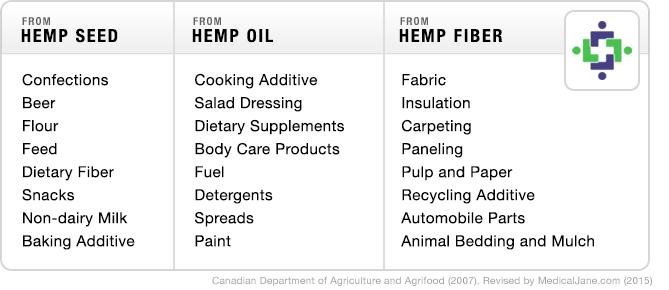
Hemp for Paper
One of the reasons hemp is so valuable is because of its fiber length and strength. These long bast fibers have been used to make paper almost for 2 millennia. Thomas Jefferson drafted both the Declaration of Independence and the U.S. Constitution on hemp paper.
 Until the early 19th century, hemp and flax were the two chief paper-making materials. In historical times, paper was processed from hemp rag. Using hemp directly for paper was considered too expensive, due to its lack of demand at the time. Wood-based paper came into use when mechanical and chemical pulping was developed in the mid 1800s in Germany and England. Today, at least 95% of paper is made from wood pulp. This makes little sense when considering hemp can easily produce much more paper per acre than wood pulp alternatives.
The hemp paper process also utilizes less energy and fewer chemicals than tree paper processing and doesn’t create the harmful dioxins, chloroform, or any of the other 2,000 chlorinated organic compounds that have been identified as byproducts of the wood paper process.
According to Hemp: A New Crop with New Uses for North America, “the primary bast fibers in the bark are 5–40 mm long, and are amalgamated in fiber bundles which can be 1–5 m long (secondary bast fibers are about 2 mm long). The woody core fibers are short—about 0.55 mm—and like hardwood fibers are cemented together with considerable lignin. The core fibers are generally considered too short for high grade paper applications (a length of 3 mm is considered ideal), and too much lignin is present.”
Hemp for Food
Studies have shown consumption of raw hemp seeds can help lower blood pressure and cholesterol, accelerate weight loss, improve one’s immune system, control blood sugar levels, and even reduce inflammation. This makes hemp seeds extremely nutritious. They contain a bundle of essential amino acids and fatty-acids. This may explain why the “hemp for food” industry is growing rapidly and has increased over 300 percent, to an estimated 25,000 products, in the past few years.
 In its raw form, hemp has the second highest amount of protein of any food (soy being the highest). However, because the hemp seed’s protein more closely resembles the protein found in human blood, it is much easier to digest than soy protein. Hemp seeds can be eaten whole, pressed into oil, or ground into flour for baking.
In America, products derived from hemp seed, such as hemp seed spreads, hemp seed energy bars, hemp seed meal, and hemp oil – are widely available in natural food stores such as Whole Foods or Trader Joe’s supermarkets.
Hemp for Health & Body
Hemp seed oil is perfectly suited for hair and skin care. Its nutritional value, combined with its moisturizing and replenishing EFA’s, make it one of the best vegetable body care foundations. Hemp seed oil’s EFA complement includes polyunsaturated fatty acids, omega-3, omega-6, omega-9, linoleic acid, and gamma linoleic acids (GLA’s). Although they are very effective in skin care maintenance, GLA’s are rarely found in natural oils. Hemp is an excellent source of GLA’s.
Additionally, oil derived from hemp seed has shown promise in treating eczema (chronic dry skin) in patients, although whole-plant cannabis oil has been proven to be more effective in treating more severe skin disorders, like skin cancer.
Hemp for Fuel
Hemp seeds have provided a combustible fuel oil throughout human history. Basically, hemp can provide two types of fuel:
1. Hemp biodiesel – made from the oil of the (pressed) hemp seed.
2. Hemp ethanol/methanol – made from the fermented stalk.
2. Hemp ethanol/methanol – made from the fermented stalk.
The concept of using oil derived from vegetables as an engine fuel is nothing new. In 1895, Dr. Rudolf Diesel developed the first diesel engine to run on vegetable oil — peanut oil to be exact. When you press the hemp seeds and extract the oil, you are actually creating hemp biodiesel. Additionally, through processes such as gasification, hemp can be used to make both ethanol and methanol.
The Controversy of Classifying Hemp vs. Cannabis
The international definition of hemp (as opposed to cannabis) was developed by a Canadian researcher in 1971 who goes by the name of Ernest Small. Small’s arbitrary 0.3 percent THC limit has become standard around the world as the official limit for legal hemp, after he published a little-known, but very influential book titled The Species Problem in Cannabis.
“There is not any natural point at which the cannabinoid content can be used to distinguish strains of hemp and marijuana. – Ernest Small”
In this same book, Small discusses how “there is not any natural point at which the cannabinoid content can be used to distinguish strains of hemp and marijuana.” Despite this, Small continued to “draw an arbitrary line on the continuum of cannabis types, and decided that 0.3 percent THC in a sifted batch of cannabis flowers was the difference between hemp and marijuana.” As you can imagine, this has led to some controversy and confusion as to what truly constitutes the difference between hemp and cannabis.
Additionally, your location will determine your understanding of what constitutes hemp vs cannabis. For instance, Health Canada defines hemp as products of Cannabis Sativa which contain less than 0.3 percent THC, whereas U.S. law defines hemp as all parts of any Cannabis Sativa plant containing no psychoactive properties, except for defined exceptions.
A recent court case between Hemp Industries Association v. DEA concluded “the DEA can regulate foodstuffs containing natural THC if it is contained within marijuana, and can regulate synthetic THC of any kind. But they cannot regulate naturally-occurring THC not contained within or derived from marijuana—i.e., non-psychoactive hemp products— because non-psychoactive hemp is not included in Schedule I.”
Tuesday, July 5, 2016
Our Water and Fluoride
We've been told that bottled Water is loaded With fluoride. Here are two list with Brand Names. One list of brands with little or no fluoride and another list of brands with high levels of fluoride. These list were found elsewhere online so please do your own research.
Here are some bottled water brands that contain little to no fluoride:
- A Better Water
- Agromas Natural Mineral Water
- Albertsons
- Alpina
- American Fare
- American Star
- Appco
- Aqua Fresca
- Aqua Panna
- Aqua Pure
- Aquarius Natural Mineral Water
- Arbor Springs
- Arlington Springs
- Aquafina Water
- Aqua Systems
- Aqua Von
- Artesian Wells
- Augusta Medical – Daniels
- Badger Water
- Besco Pure Premium Drinking Water
- BIOTA Colorado Pure Spring Water
- Bio-2
- Black Berry Farms
- Blue Ice Natural Mineral Water
- Boney’s
- BORNEO
- Bountyland
- Buches
- Calistoga
- Callaway Blue
- CAPA
- Cascade
- Century Springs
- Chemung
- Chippewa Spring Water
- Citi Stop
- Classic Selection
- Clearly Arctic
- Clear Mountain Spring Water
- Clover Company Limited
- Coach
- Cold Country
- Cohutta Mountain Spring Water
- Cowboy Squeeze
- Crowne Plaza Drinking Water
- Crowne Plaza Natural Mineral Water
- Cruel Jacks Spring Water
- Crystal Mountain Spring Water
- Crystal Point
- Crystal Ridge
- Crystal Spring Natural Spring Water
- Culligan Water
- Dakota Splash
- Dannon
- Deep Rock
- Deep Rock Crystal Drop
- Deep Rock Fontenelle
- Deja Blue
- Desert Quench
- East Phils
- Eco Quest
- Elite
- Equatorial Natural Mineral Water
- Essentia Water
- Eureka
- Evian
- E Water
- Family Pantry
- Famous Ramona Water
- Flowing Springs
- Food Club
- Founders Square Bank
- Fresh Brands Artesian
- Fresh Brands Distilled Water
- Fresh Brands Drinking Water
- Fresh Market
- Get-N-Go
- Glacier Bay
- Glen Summit Springs Water
- Glen Summit Distilled Water
- Glenwood Inglewood
- Gordon Food Service
- Great Bear
- Great Value
- Harvey’s
- H2O4U
- Henry’s
- Hidden Valley Natural Mineral Water
- Hillcrest Distilled Water
- Hillcrest Drinking Water
- Hillcrest Spring Water
- Hilton PJ Natural Mineral Water
- Hinckley Springs
- HINT
- Hi-Sprint Drinking Water
- Hi-Sprint Natural Mineral Water
- Hog Wash
- Hon Less Natural Mineral Water
- Ice Jam
- Inland
- Istana Natural Mineral Water
- Joe Muggs
- Joe Ragan’s Pure Water
- Junior Johnson
- Just Squeezed
- KLGCC Natural Mineral Water
- Kroger Bottled Water (Reverse Osmosis)
- Krystal J Artesian Water
- Krystal J Distilled Water
- Laure
- Leroy Jenkins Ministries
- Logansport Savings Bank
- Lowe’s
- Martins
- Masafi Pure Natural Mineral Water
- Mercurio Produce
- Mesra Drinking Water
- Mesra Natural Mineral Water
- Misty Mountain
- Monadnock Mountain Spring Water
- Montclair
- Mountain Energy
- Mountain Forest
- Mountain Valley Spring Water
- Mutiara Natural Mineral Water
- Nantze Springs
- New Frontier Bank
- Niagra Mist
- Nicolet Distilled
- Northern Illinois University
- Oasis Pure Drinking Water
- Oasis Sparkling Water
- Ogallala – Clear Cool Water
- OUI Drinking Water
- OUI Natural Mineral Water
- Paiges
- Parmer Pure H2O
- Patriots Choice
- Pelangi Natural Mineral Water
- Penta Ultra Premium Purified Drinking Water
- Piggly Wiggly
- Polaris Water
- Pristine Natural Artesian
- Purely Sedona
- Quick Stop
- Rain Soft
- Refresh Natural Mineral Water
- Reiser Drinking Water
- Request Foods, Inc.
- Rip Time
- Roundy’s “Purified Water”
- Safeway – Refreshe
- Sam’s Wine & Spirits
- San Faustino Natural Mineral Water
- San Pellegrino
- Santee Springs
- Scheopner’s Water
- Sequoia Springs
- Scotts
- Shamrock
- Shop-N-Cart
- Shur-Fine
- Silver Creek Purified Water
- Silver Creek Spring Water
- Sky Drinking Water
- Smart Water
- Snow Valley
- Spinx
- Stator Bros. Markets
- Summit Mountain
- Summit Springs
- Summit Valley
- T-Rex
- Teton Mountain Lodge Spring Water
- Tweetsie
- United Dairy Farmers
- Volvic
- Vitamin Water
- Veta Drinking Water
- Valutime
- Whistler Water
- Whole Foods 365
- Woodland Spring Water
- Wyoming Machinery “Catipillar” Spring Water
- Zodiac
- List of brands to avoid that are known to be high in fluoride:
- Alhambra
- Arrowhead
- Belmont Springs
- Crystal Rock
- Crystal Springs
- Deer Park
- Diamond Springs
- Hindley Spri
- Ice Mountain
- Kandiyohi
- Kentwood Springs
- Mayer Bros.
- Mount Olympus
- Nursery Water
- Ozarka
- Poland Spring
- Pure Flo
- Puritan Springs
- Shenandoah
- Sierra Springs
- Sparkletts
- Zephyrhills
Subscribe to:
Posts (Atom)